Cranial Nerves
Assessment techniques for cranial nerve function
This educational resource covers the examination of cranial nerves, specifically focusing on testable nerves including the trigeminal (V), facial (VII), and spinal accessory (XI).
Facial Nerve (VII)
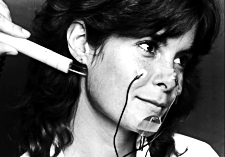
Examination Method
The facial nerve is assessed by measuring latency and amplitude from a single stimulation site. Nerve conduction velocities are not calculated.
Stimulation Placement
- Primary site: Electrodes positioned behind the jaw angle, with the cathode posterior to the earlobe
- Alternative site: Cathode over the stylomastoid foramen, anode over the mastoid
Recording Locations
Active electrodes may be placed over:
- Orbicularis oris (mouth corner)
- Orbicularis oculi (outer eye canthus)
- Frontalis (forehead)
- Nasalis (nasolabial fold)
Reference electrodes are typically placed on the nose.
Trigeminal Nerve
Blink Reflex Testing
The trigeminal nerve evaluation uses reflex activity analysis. When the supraorbital branch is stimulated, contraction of the orbicularis oculi muscles bilaterally occurs.
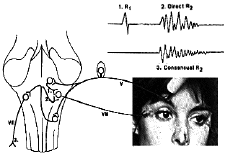
Recording setup: Active electrodes over orbicularis oculi muscles on both sides; reference electrodes on the nose; single ground electrode on the chin.
Response patterns:
- Ipsilateral channel shows both direct (short latency) and indirect (long, variable latency) responses
- Contralateral channel shows only indirect response
Blink Reflex Findings
- Unilateral trigeminal lesions affect all three responses equally
- Unilateral facial nerve lesions produce asymmetric responses depending on stimulation side
Jaw Jerk Test
Uses percussion hammer stimulation with bilateral masseter muscle recording.