Pathological Processes
Disease mechanisms visible in nerve conduction studies
Understanding how pathological processes affect nerve conduction studies is fundamental to interpreting findings. Three primary mechanisms are discussed:
1. Demyelination
Key characteristics:
- Latencies and conduction velocities are affected most
- Sensory fibers typically affected first
- Sensory nerve action potentials show increased duration, reduced amplitude, and prolonged distal latency
- Motor fibers affected similarly at later stages with conduction velocities decreased to 50% below normal
- Advanced cases may show absent sensory responses entirely
Focal vs. Diffuse:
- In entrapment/pressure neuropathies, demyelination is localized; nerve remains normal above and below lesion
- Stimulation above entrapment shows slowed velocity; stimulation below yields normal velocity
- In polyneuropathies, changes occur diffusely, though potentially more severe at pressure points
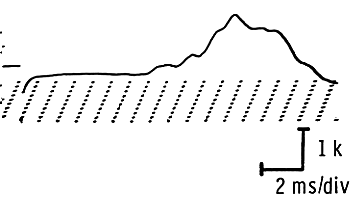
Temporal dispersion:
2. Conduction Block
Mechanism:
Blocks arise from severe focal demyelinating lesions preventing impulse propagation, or physiological interruption without histological abnormalities.
Types:
- Partial blocks: Only some fibers affected; stimulation above lesion produces low-amplitude response
- Complete blocks: No response obtainable above lesion; normal response when stimulating below
Associated findings:
Partial blocks sometimes accompany focal demyelination, showing low-amplitude response with slowed velocity above the lesion and normal parameters below.
3. Axonal Loss
Distinguishing features:
- Primarily causes decreased amplitudes rather than latency changes
- Sensory fibers affected first with amplitude reduction but preserved distal latencies
- Motor amplitudes decrease; sensory potentials may become unobtainable
Advanced disease:
In severe cases, motor amplitudes depress sufficiently to prolong distal latencies and slow conduction velocities (typically not exceeding 30% below normal). This results from dropout of fastest-conducting fibers.
Critical difference from conduction block:
Low amplitude from axonal loss cannot be corrected by stimulation below the lesions. The nerve segment undergoes Wallerian degeneration distal to injury. However, evoked responses can still be obtained up to 96 hours following complete nerve transection.