Needle Electrodes
Equipment and electrode selection for needle studies
To assess individual motor units within muscle tissue, an electrode must be inserted directly into the muscle. This section describes needle electrodes used for this purpose. Like all electrical equipment applications, a ground electrode is necessary and should be positioned on the same limb being examined. A plate electrode works best for grounding and offers optimal patient tolerance, though uninsulated needles have been used historically.
The electromyographer selects which needle electrode type to use, with preference given to consistent use of a single type to develop familiarity with its characteristics.
Monopolar Needle
This stainless steel electrode features a very sharp point covered with Teflon or similar insulation along its entire length, except for a 0.5 mm exposure at the tip. The needle functions as the active electrode while a surface electrode on nearby skin serves as reference.
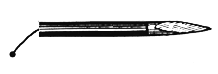
Advantages: Patients tolerate these better due to small diameter; the Teflon coating enables smooth insertion and withdrawal with minimal discomfort.
Disadvantages: Repeated use degrades the bare tip, limiting reusable examinations. Teflon peeling exposes larger areas, altering recorded motor unit potential characteristics. The separation between active and surface electrodes increases background noise from remote muscle contractions.
Concentric Needle
Composed of a cannula with an insulated wire (or wires) through its center, the active electrode is the center wire’s small tip while the outer cannula serves as reference. Bipolar versions contain two central wires.

Advantages: Closer proximity between active and reference electrodes minimizes background noise. Pickup is limited to very small distances. No separate surface electrode is required.
Disadvantages: Larger diameter causes more patient discomfort than alternatives. Moving the electrode proves uncomfortable. Small-gauge versions prone to bending when dulled. Can be resharpened with fine honing stone.
Single-Fiber Needle
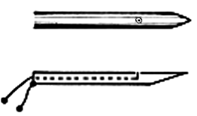
Designed for specialized studies, this consists of a 0.5-0.6 mm stainless steel cannula containing a 25 µm platinum wire. The platinum wire’s cut end is exposed through a side port 3 mm behind the tip.
Surface Electrode
These electrodes effectively capture gross motor unit activity but struggle with evaluating individual motor unit potentials. They function best as reference electrodes with monopolar needles. Applications include kinesiology for gross muscle activity assessment and gait analysis.