H-Reflex and F-Wave
Reflex testing methodologies
H-Reflex
The H-reflex represents the electrical equivalent of the monosynaptic stretch reflex and is normally obtained in only a few muscles. Clinicians elicit it by selectively stimulating Ia fibers using slow stimuli with gradually increasing strength.
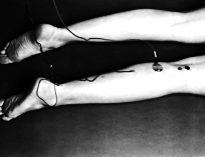
The signal pathway travels along Ia fibers through the dorsal root ganglion, crosses the central synapse to activate the anterior horn cell, then travels along the alpha motor axon to produce a motor response of 0.5-5 mV amplitude at low stimulation strength.
Common sites for H-reflex recording:
- Soleus muscle (posterior tibial nerve at popliteal fossa)
- Flexor carpi radialis muscle (median nerve at elbow)
- Quadriceps (femoral nerve stimulation)
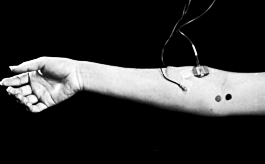
A sweep of 5-10 ms/division is necessary to visualize the H-reflex due to its longer latency compared to the M response.
Progression with increasing stimulation:
- H-reflex appears at low stimulation strength without motor response
- Direct motor response emerges with increased stimulation
- M response grows larger while H-reflex decreases in amplitude
- When M response becomes maximal, H-reflex disappears, replaced by F-wave
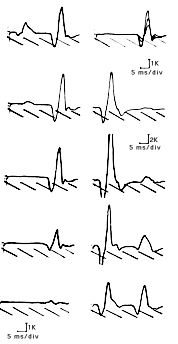
Clinical significance: H-reflex latency should not exceed 1 ms difference between limbs. The test helps diagnose S1 and C7 root lesions and proximal nerve segment abnormalities. Its absence on one side suggests localized disease, though bilateral absence in asymptomatic patients remains controversial.
F-Wave
The F-wave is a long latency muscle action potential seen after supramaximal stimulation to a nerve. It’s best obtained in small foot and hand muscles.
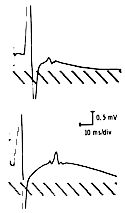
Generation mechanism: The stimulus travels antidromically along motor fibers, reaching the anterior horn cell at a critical depolarization moment. The response fires back along the axon, causing minimal muscle contraction.
Characteristics:
- Always preceded by a motor response
- Small amplitude (0.2-0.5 mV)
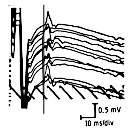
- Variable and infrequently obtained after single stimulation
- Multiple supramaximal stimuli typically required
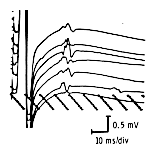
Data collection: Ten to twenty F-waves are typically obtained, with the shortest latency F-wave used for analysis. The shortest latency difference between limbs should not exceed 1 ms.
F-Wave Ratio Analysis
The F-wave ratio helps determine proximal versus distal pathology using this formula:
Proximal latency = (Fprox – Mprox – 1 ms) / 2
F-ratio = (Fprox – Mprox – 1 ms) / 2 × Mprox
Interpretation with normal conduction velocity:
- Normal F-ratio: normal proximal and distal segments
- Decreased F-ratio: distal nerve lesion or entrapment
- Increased F-ratio: proximal slowing
Interpretation with slowed conduction velocity:
- Normal F-ratio: equal proximal and distal slowing
- Decreased F-ratio: normal proximal segment
- Increased F-ratio: predominant proximal involvement